
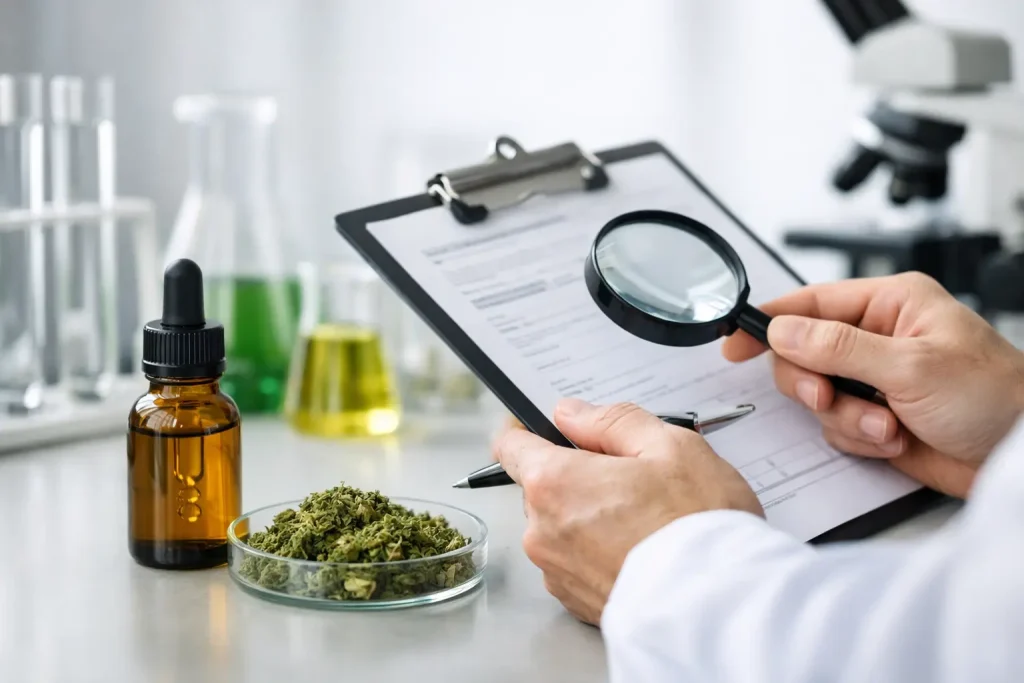
A CBD bottle can look premium, make broad promises and carry a familiar wellness claim. CBD lab reports are where you find out what is actually in it. They turn phrases such as “broad spectrum”, “THC-free” and “independently tested” into information you can check before making CBD part of your routine.
For anyone choosing CBD to support calmer evenings, more settled sleep, recovery after training or everyday balance, this matters. A lab report will not promise a particular result for you. What it can do is help you select a product with greater confidence, based on its contents, quality controls and traceability.
What are CBD lab reports?
A CBD lab report is usually a Certificate of Analysis, often shortened to COA. It is produced by a laboratory that tests a sample of a CBD product. The report should identify the product or batch tested, explain which tests were carried out and show the results.
The most useful reports come from an independent third-party laboratory, rather than being solely an internal quality check. Independent testing provides an additional layer of reassurance because the laboratory has no reason to overstate a product’s cannabinoid content or overlook an unwanted substance.
Not every COA looks identical. Laboratory layouts, testing methods and terminology vary. But a clear report should allow you to answer three practical questions: does this match the product I am buying, does it contain the advertised level of CBD, and has it been screened for relevant contaminants?
Why a batch-specific report matters
Hemp is a botanical ingredient, and natural materials can vary between harvests. Extraction, flavouring and the final manufacturing process can also affect the finished product. That is why a generic report from several years ago is not as useful as one connected to the batch in your hand.
Start by looking for a batch or lot number on the label and on the report. They should match. If a report refers to a different strength, flavour, format or product name, treat it as background information rather than proof of the exact product you intend to use.
A sensible CBD brand also makes its testing information straightforward to find and readable enough to use. Transparency is not simply having a technical document available somewhere. It is giving customers a clear route from product to batch to result.
How to read the cannabinoid panel
The cannabinoid profile is often the first part of a COA. It lists compounds measured in the sample, usually including CBD and THC. Depending on the product, you may also see cannabinoids such as CBG, CBC or CBDV.
For a broad-spectrum CBD oil, gummy, drink or topical, the key figure is the amount of CBD. Reports may show this as a percentage, milligrams per gram, milligrams per millilitre or a total milligram amount. The label should provide enough information to make a sensible comparison.
For example, a 10 ml oil labelled as containing 1,000 mg CBD should broadly correspond with the result on its report. A small degree of variation can occur due to laboratory tolerances and the way figures are expressed. A major mismatch deserves a question.
Broad spectrum means the product is formulated to contain CBD alongside selected naturally occurring hemp compounds, while avoiding THC. It is not the same as full spectrum, which may contain trace levels of THC. Check the report rather than assuming the terms are interchangeable.
THC results and “not detected”
A report may show THC as “ND”, meaning not detected, or below a laboratory’s limit of detection or quantification. This is a useful distinction. “Not detected” does not mean a machine can prove that no molecule exists. It means the test did not find THC at or above the level it can reliably detect.
If avoiding THC is particularly important to you, look for a clearly stated THC result and choose a brand that explains its testing and formulation approach. This may be especially relevant for people subject to workplace drug testing, although no CBD product can guarantee the outcome of a drug test. Speak to your employer or testing provider if this is a concern.
The contaminant checks worth looking for
Cannabinoid strength tells only part of the story. A quality CBD product should also be assessed for substances that do not belong in your daily wellness routine. The exact panel depends on the format and ingredients, but a comprehensive testing approach commonly considers:
- Heavy metals, such as lead, arsenic, cadmium and mercury
- Pesticides and herbicides that may be associated with cultivation
- Residual solvents from extraction processes
- Microbiological contaminants, including mould, yeast and harmful bacteria
- Mycotoxins or other relevant contaminants where appropriate
The result may appear as “pass”, “not detected” or a numerical figure set against an accepted limit. Look for clear indication that the product meets the laboratory’s applicable specification. If you see a number, it is not automatically a problem – the relevant question is whether it is within the stated safe limit for that test.
This is also where product format matters. An oil made with a simple carrier oil will not necessarily need the same assessment as a gummy with several food ingredients, or a topical designed for use on the skin. The right report reflects the product, rather than presenting one incomplete test as evidence for an entire range.
What a COA cannot tell you on its own
A lab report is powerful evidence of quality, but it is not a complete picture of a product. It cannot tell you whether the flavour suits you, whether an oil fits easily into your evening routine, or how your individual body will respond to CBD.
It also does not replace checking the ingredient list. If you follow a vegan diet, have allergies or are avoiding particular sweeteners, carrier oils or flavourings, read the product label as well as the COA. Organic sourcing and non-GMO ingredients are valuable quality considerations too, but they may be supported by separate certification rather than the laboratory report itself.
For targeted needs, such as sleep disruption, stress or post-exercise recovery, think about the entire formulation and how you will use it consistently. CBD is not a substitute for a varied diet, healthy lifestyle, prescribed medicine or medical advice.
A practical way to compare CBD lab reports
When comparing two products, resist the temptation to focus only on the biggest CBD number. A higher strength may be better value for an experienced user, but it may not be the most suitable place to start. The best choice depends on your routine, the format you prefer and the amount of CBD you plan to take.
Check that the report is recent and batch-specific, then compare the labelled CBD content with the laboratory result. Confirm that THC is consistent with the product’s broad-spectrum positioning. Finally, look for a contaminant panel that is relevant to the product and clearly passed.
This approach helps cut through impressive-looking packaging. It also makes comparison fairer: a lower-priced product with no accessible batch report may not offer the same reassurance as one supported by comprehensive, independent testing.
Questions to ask before choosing a CBD product
If a lab report is unclear, ask the retailer or manufacturer for help. A dependable answer should explain which batch was tested, who carried out the testing and what the results mean in plain English.
You may want to ask whether the report is for the final product or only for the hemp extract. Testing the final formulation is particularly useful, as it confirms the contents after blending and manufacturing. For a CBD gummy, drink, tea or topical, that distinction can matter.
For pet CBD, choose products made specifically for animals and follow the feeding guidance closely. Pets have different needs, and human CBD products may contain ingredients that are not suitable for them. It is sensible to speak with a vet before introducing any new supplement, especially if your pet is unwell or taking medication.
Transparency is part of premium CBD
At Purity Hemp Company, quality is built around traceability, broad-spectrum formulations and independent testing. That standard is not about making lab reports feel complicated. It is about giving you useful evidence that supports an informed, everyday choice.
The right CBD product should feel easy to understand before it becomes part of your cupboard. Take a moment to read the batch report, start with the serving guidance and give your routine time to become familiar. Confidence in CBD begins with knowing exactly what you have chosen.

