
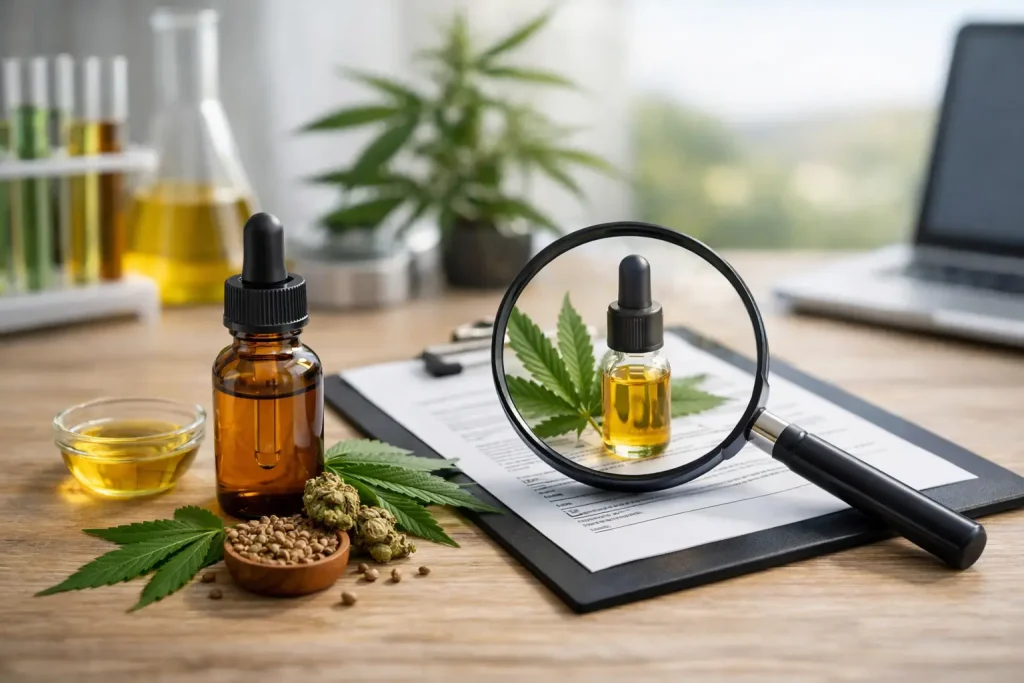
A CBD bottle can look premium, carry a high-strength claim and still leave the most useful question unanswered: where did the CBD actually come from? Knowing how to assess CBD traceability gives you a clearer way to judge quality than packaging, flavour or marketing language alone. It lets you follow a product from the hemp plant to the finished oil, gummy, capsule or topical in your hand.
For everyday wellness, this matters. You want to know that the product is made with care, that its contents match the label, and that independent testing has checked for the things that should not be there. Traceability turns those expectations into evidence.
What CBD traceability should show you
CBD traceability is the documented trail behind a product. At its best, it identifies the hemp source, how the extract was made, where it was formulated and packaged, and which test results relate to the exact batch being sold.
This is more than a nice-to-have detail. Hemp is a bioaccumulator, meaning it can absorb compounds from the soil in which it grows. Growing standards, farming practices and testing therefore influence the quality of the extract long before CBD reaches a bottle. A traceable supply chain helps a brand identify and manage issues at each stage rather than simply making a broad promise of purity.
Complete seed-to-shelf traceability does not mean every customer needs a folder full of technical documents. It means the information is available, clear and connected. A retailer should be able to explain the product’s journey without vague answers such as “European-grown” or “lab tested” with no further detail.
How to assess CBD traceability in practice
Start with the origin of the hemp. Responsible brands should state the country or region where their hemp is grown, rather than hiding behind generic claims. A named farm or grower group is even better, although commercial confidentiality can mean that not every supplier is publicly identified. What matters is that the brand can verify its source and apply consistent standards to it.
Organic credentials can offer useful reassurance, particularly where they relate to the cultivation of hemp. Look for a clear statement of what is certified and by whom. “Made with natural ingredients” is not the same as certified organic hemp, and neither claim replaces batch testing of the finished product.
Next, consider the route from plant to extract. A transparent product description should tell you whether it contains full-spectrum, broad-spectrum or CBD isolate. These are not interchangeable terms. Broad-spectrum CBD contains a range of naturally occurring hemp compounds while being formulated without THC. For UK customers who prefer a THC-free option, this distinction is particularly relevant.
The extraction method can also be worth checking. Methods such as CO2 extraction are widely used because they can produce a clean, controlled extract. However, extraction method alone is not proof of quality. It must be paired with reliable sourcing, careful formulation and independent analysis. A technically impressive process means little if there is no evidence connecting it to the batch you are considering.
Check the batch number first
The simplest traceability test is often on the pack. Find the batch number, lot number or best-before code. It should be legible and should relate to a certificate of analysis, often called a COA.
A COA is a laboratory report for a sample of that batch. Many brands make these available via a QR code, product page or customer support team. A QR code is convenient, but it is not the standard in itself. The key question is whether the report is easy to obtain and whether its batch number matches the product you are buying.
Be cautious if a brand only shows one undated report across an entire range, or if the certificate does not identify a batch. CBD oils, gummies and drinks can contain different ingredients and strengths, so a test for one product cannot automatically verify another. The report should be relevant to the finished format, not just a raw CBD ingredient used somewhere in production.
Read a COA without getting lost in the science
You do not need to be a chemist to spot whether a COA is meaningful. Begin with the laboratory details. The report should name the testing laboratory, show a date and identify the sample or batch. An independent laboratory provides stronger reassurance than an in-house result because the analysis comes from outside the manufacturer.
Then compare the cannabinoid results with the label. If an oil claims 1,000mg CBD, the certificate should support the stated concentration within a reasonable manufacturing tolerance. Results can be displayed in milligrams per bottle, milligrams per gram or as a percentage, so take a moment to compare like with like. If the figures are unclear, a trustworthy brand should be ready to explain them plainly.
For a THC-free broad-spectrum product, look for testing that addresses THC specifically. “Not detected” can be reassuring, but it should be read alongside the laboratory’s limit of detection or limit of quantification. These figures show the lowest amount the test can reliably find or measure. A clear report gives the context behind the claim rather than relying on a headline alone.
A comprehensive COA should also assess safety markers relevant to hemp-based products. These commonly include pesticides, heavy metals, residual solvents and microbiological contaminants such as yeast, mould and bacteria. The exact testing panel can vary by product type and extraction process, but a brand should be able to demonstrate that it has considered the main risks.
Look for a connected chain, not isolated claims
Traceability is strongest when the details agree across the label, website information, laboratory report and customer service response. If a bottle says broad-spectrum and THC-free, the product description and test results should support that. If the brand says its hemp is organic, it should be able to clarify the certification behind the claim.
It also helps to distinguish between traceability and compliance. A product’s status within the UK’s CBD regulatory framework is a useful legitimacy check, but it does not by itself tell you where the hemp was grown, which batch was tested or how the product was made. Good compliance and good traceability should work together.
At Purity Hemp Company, seed-to-shelf information and independent testing are central to the standard expected from premium broad-spectrum CBD. That approach is valuable because it makes quality something customers can review, not simply take on trust.
Questions worth asking before you buy
If the information is not immediately available, ask the brand where its hemp is grown, whether the finished product has been independently tested and how you can access the COA for the batch you will receive. You can also ask whether the product is broad-spectrum, full-spectrum or isolate, and what THC testing has been completed.
The response matters as much as the answer. Clear, specific language suggests that the business understands its supply chain. Overly technical wording can sometimes obscure a lack of detail, while claims such as “premium”, “pure” or “lab verified” should always be supported by records.
There are a few warning signs to keep in mind. Avoid products with no batch number, no accessible testing, unclear CBD amounts or contradictory statements about THC. Be wary of health claims that promise to treat, cure or prevent a medical condition. CBD is a wellness product, and responsible brands should communicate its role with care rather than certainty that no supplement can justify.
Price deserves perspective too. A lower price does not automatically mean poor quality, but meaningful traceability involves cultivation controls, formulation checks, batch handling and laboratory analysis. Those steps carry a cost. The better comparison is value: whether the product provides clear CBD content, appropriate testing and a supply chain you can understand.
The most reassuring CBD purchase is not the one with the loudest promise. It is the one that allows you to follow the evidence, match it to the product and choose a format that suits your routine. When a brand can show its work from seed to shelf, you have a sounder basis for making wellbeing part of your day.

